The Beginning
Before 1967, post-primary education was provided in (voluntary) secondary schools; vocational schools; secondary tops; preparatory colleges and juniorates of religious orders and congregations. Although government funding for voluntary secondary schools was limited, and all schools had to charge fees, the numbers of pupils attending secondary education grew from about 25,000 in the mid-1920s to 80,000 in the early 1960s. The number of secondary schools had grown from 283 to 526 during the same period.
-
May 1963

Comprehensive Schools Announced
In May 1963, the Minister for Education (and future President of Ireland) Dr. Patrick Hilary, announced the creation of a new type of post-primary school, the Comprehensive School. The Schools would be built in areas that did not have existing vocational or secondary schools and would be ‘coeducational, open to all abilities and offer a wide curriculum to match the aptitude of their pupils’ and ‘a step towards equality of educational opportunity’ -
December 1965
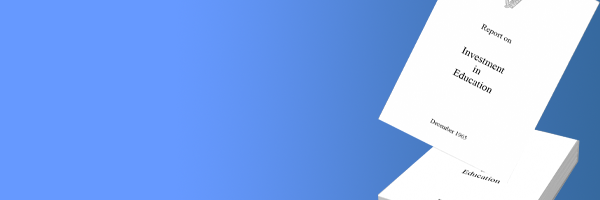
Investment in Education Report published
The Investment in Education report (1965) was a groundbreaking study that exposed major inequalities within the Irish education system. It found that large numbers of students left school early, with only a small proportion completing secondary education or progressing to university. Educational attainment was strongly linked to social class, as children from professional families were far more likely to complete senior cycle and attend university than those from unskilled or unemployed backgrounds. The report also highlighted disadvantages faced by rural students due to limited access to post-primary schools. By revealing the scale of educational inequality and underachievement through detailed statistical evidence, the report made a powerful case for reform and became a key influence on Irish educational policy in the years that followed. -
Dec '65 - July '66

George Colley as Minister
George Colley was appointed Minister for Education in May 1965. He stated that it was his intention to raise the school-leaving age to 15 in 1970, and to develop a system of secondary education which would provide junior cycle schooling for all – to be followed by two years in senior cycle. This would coincide with extending the then two-year course in vocational schools to three years. Postprimary education would be organised on comprehensive lines ‘wherever conditions are favourable.’ -
July 1966

Appointment of Donagh O'Malley
In 1966, Taoiseach Seán Lemass pledged to make education a top government priority and appointed Donogh O'Malley as Minister for Education. Shortly after taking office, O'Malley pushed for the rapid introduction of free post-primary education, despite advice from senior officials to delay the reform until 1970. Drawing on planning and costings already prepared by Department of Education officials, particularly Bill Hyland, O'Malley submitted a memorandum to the Taoiseach on 7 September 1966 outlining two schemes: one providing free education up to Intermediate Certificate level with means-tested senior cycle support, and another offering free education for all students up to Leaving Certificate level in vocational, comprehensive, and low-fee secondary schools. The proposals also included a school transport scheme and additional assistance for disadvantaged students, laying the foundation for a landmark reform that greatly expanded access to secondary education in Ireland. -
September 1966

The Announcement
On 10 September 1966, before the Cabinet had approved his proposals, Donogh O'Malley dramatically announced at a National Union of Journalists conference that free post-primary education would be available to all children from September 1967. Condemning the fact that around 17,000 children each year ended their education after primary school, he described this inequality as a "dark stain on the national conscience" and pledged that no child would be denied secondary education because of lack of money. His plan included free education in vocational, comprehensive, and most secondary schools, along with support for books, equipment, and school transport, particularly for disadvantaged students. The announcement received widespread public and media support, with many praising its potential to transform Irish society and expand educational opportunities. However, senior officials in the Department of Finance, including T.K. Whitaker and Finance Minister Jack Lynch, reacted angrily because O'Malley had bypassed normal approval procedures. Despite this opposition, it is widely believed that Taoiseach Seán Lemass quietly supported the initiative. Historians later described the announcement as one of the most significant educational reforms in modern Ireland, helping to remove social barriers to education and greatly increasing access to secondary schooling. -
September 1966

The first Comprehensive Schools Open
The first three Comprehensive schools were opened in 1966 in Carraroe, Shannon and Cootehill. In these co-educational schools no selection would occur at entry, they would be open to all classes and levels of ability. Comprehensive schools were established and fully funded by the state. The introduction of the common Intermediate Certificate course in 1966 contributed to a wider subject range, and the comprehensive schools also offered more practical subjects.